 27 minutes read
The strongest approach to legal research assistant jobs is a targeted mix of HireParalegals, legal staffing firms, and legal job boards, followed by role-specific applications and direct outreach. Each channel differs in specialization, work arrangement, and job stability, so using several at once gives candidates a better view of permanent, remote, contract, and project-based opportunities.
A candidate searching today may type “legal research assistant” into a job board and find a confusing mix of titles. One firm may call the role a legal assistant, another may use legal practice assistant, legal researcher, litigation support specialist, or paralegal. The responsibilities can range from case-law research and citation checking to filings, discovery, drafting, immigration procedures, and case-file management.
That variation makes the source of the listing matter. A specialized legal platform can surface closer matches, staffing firms can open contract and contract-to-hire paths, and broader legal boards can reveal employers that don't recruit through niche channels. The best search isn't one application sent repeatedly. It's a controlled pipeline built around role fit.
This guide compares 10 resources for legal research assistant jobs, starting with the most specialized option and moving through staffing firms, project-based providers, and legal job boards. It also explains how to identify remote and part-time possibilities where listings support them, tailor applications to research-heavy work, benchmark compensation without relying on unsupported figures, and evaluate candidates from a law-firm perspective. The profession itself is established but stable: the U.S. Bureau of Labor Statistics outlook for paralegals and legal assistants reports about 404,900 jobs in 2025 and projects 403,800 by 2035, classified as 0% growth. That makes specialization, replacement hiring, and practical workflow skills especially relevant.
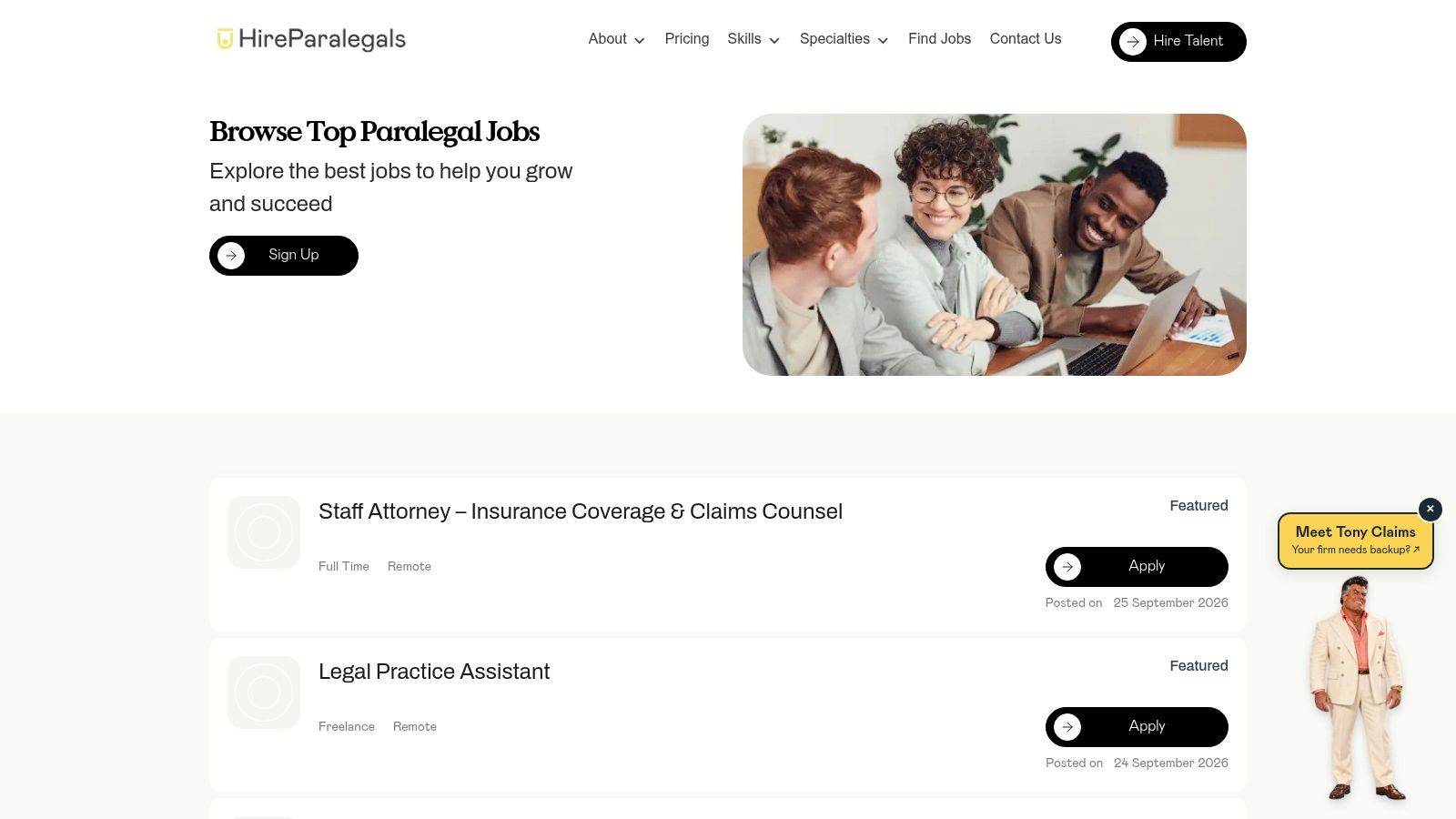
Find Jobs on HireParalegals is the most targeted starting point for candidates who already know they want legal support work rather than a general administrative position. The board is built around paralegals, legal research assistants, Legal Practice Assistants, and Legal Researchers, with openings associated with areas such as immigration, litigation, corporate, and family law.
The value is relevance. Instead of sorting through unrelated office roles, candidates can focus on legal positions and use filters for specialty, location, and job type. Where a listing supports it, that can include full-time, freelance, or remote work. A research-oriented candidate should still read each description carefully, because a title alone won't tell you whether the employer expects case-law analysis, document drafting, docket monitoring, discovery support, or general attorney assistance.
HireParalegals connects its legal jobs activity with a curated, on-demand talent platform serving U.S. law firms. That makes it useful for experienced candidates who want their application seen in a context where legal knowledge, writing quality, and practice-area familiarity carry more weight than generic administrative experience.
The platform's legal researcher role description emphasizes conducting research, drafting documents, managing case files, and gathering and analyzing legal information to support attorneys. Those responsibilities are a useful checklist when adapting a résumé. A candidate shouldn't write “legal research.” A stronger description identifies the authorities searched, the type of memorandum or summary prepared, the case-management work completed, and the attorney or team supported.

Practical rule: Apply to the work behind the title, not the title alone. A legal assistant posting with research, filing, and drafting duties may be a closer match than a role labeled “research assistant” that mainly involves data entry.
The main trade-off is scope. HireParalegals is narrower than a general job board and is oriented toward U.S. legal employers, so it won't replace a wider search. Entry-level candidates may also find that some openings expect prior legal support experience. For mid-level professionals seeking specialized or remote work, however, the narrower pool can reduce wasted applications and make it easier to compare roles by practice area and arrangement.
Candidates should create saved searches, check new postings regularly, and prepare separate résumé versions for litigation research, immigration support, corporate work, or general legal administration. Firms can use the same specialization to define a brief before reviewing applicants, particularly when they need remote legal talent who can work independently in the firm's operating hours.
Robert Half Legal is a practical channel for candidates who want access to a national legal staffing network rather than only direct employer applications. Its legal practice group works with law firms and corporate legal departments and can present roles across legal assistant, paralegal, litigation, corporate, intellectual property, compliance, and legal operations functions.
Candidates may encounter remote, hybrid, and on-site arrangements, depending on the client. The engagement can also vary. Contract work may suit someone building recent experience or seeking flexibility, while contract-to-hire can provide a path to a permanent position without requiring the employer to make an immediate long-term commitment. Direct-hire roles are more appropriate when the candidate's priority is stable employment from the outset.
A recruiter can't position you well without a specific brief. Tell the recruiter which research tasks you handle confidently, which databases you've used, whether you can draft memoranda or correspondence, and whether you're open to litigation support, discovery, filings, or general legal administration.
Mention work preferences early. A candidate who says only “remote preferred” may be overlooked if the client requires occasional office attendance. Clarify whether you're seeking fully remote work, hybrid work within a particular region, contract assignments, or permanent employment.
The trade-off is consistency. Candidate experience can differ by local office and recruiter, and some client roles may be fully on-site. Treat the recruiter as one route into the market, not as a substitute for reviewing the actual employer, duties, reporting line, and expected schedule.
Beacon Hill Legal is a legal-dedicated staffing division that places legal assistants, paralegals, and litigation support professionals across U.S. markets. It can be particularly relevant when research is bundled with filings, discovery, document organization, or practice-specific case support.
A candidate may find contract, contract-to-hire, and direct-hire opportunities, with a mix of local and remote positions. The practice coverage can include litigation, healthcare, intellectual property, and other specialized areas. That matters because a research assistant with healthcare or IP experience may be evaluated differently from someone whose background is primarily family law or immigration.
Don't send one generic résumé to every Beacon Hill contact. For a litigation role, foreground research memoranda, deposition preparation, discovery review, docket work, and filing coordination. For a healthcare role, explain how you handled regulated information, policy research, medical records, or administrative coordination without implying that you performed clinical or licensed work.
Recruiter relationships are another variable. Activity and communication can differ by market and individual recruiter, so candidates should ask direct questions about the client, work arrangement, assignment length, conversion possibility, and interview process. Those details determine whether a role is a sensible career move or only a short-term bridge.
A firm hiring through a staffing partner should provide a usable role profile. “Legal assistant needed” isn't enough. Specify the practice group, expected research output, systems used, supervision level, working hours, and whether the role requires independent deadline management. That precision helps the recruiter screen for actual fit instead of forwarding broadly qualified applicants.
Adams & Martin Group focuses exclusively on legal staffing and recruits legal assistants, paralegals, and other legal support professionals for law firms and corporate legal departments. Its openings can include temporary, temp-to-hire, and direct-hire arrangements across practice areas and U.S. markets.
The firm's legal specialization is useful for candidates who want a recruiter familiar with law-office terminology and support structures. It also publishes a legal salary guide, which gives candidates and employers a structured reference point when discussing an offer. A salary guide isn't a promise that a specific role will pay a particular amount. Compensation still depends on geography, practice area, experience, duties, arrangement, and the employer's budget.
Candidates should compare the guide's categories with the actual role. A position titled legal assistant may contain substantially different work depending on whether it supports one attorney, a litigation team, an immigration practice, or an in-house department. Research, drafting, discovery, client communication, and specialized procedural knowledge can change the level of responsibility without changing the title.
Employers should make the same comparison before setting a range. If the job requires advanced research, rapid drafting, and independent case-file management, benchmarking it against a purely clerical assistant role can produce weak applicant flow or poor retention. If the work is mainly repetitive document processing, describing it as a research role creates a different kind of mismatch.
Some AMG roles are market-specific and on-site. Candidates who require remote work should confirm location and attendance expectations before investing time in interviews. Firms should state those expectations in the initial posting, including whether “hybrid” means occasional attendance or a regular office schedule.
LHH Recruitment Solutions Legal and Compliance gives candidates access to a national recruiting channel serving both law firms and corporate legal teams. Its legal recruiting heritage includes the Special Counsel brand, and its work can span legal assistants, paralegals, direct-hire placements, and large legal projects.
This resource is especially relevant to candidates who are open to project-based research and analysis. Document review assignments may involve issue coding, privilege review, factual organization, quality checks, and escalations. That experience can strengthen a résumé, but it isn't identical to producing attorney-facing legal research memoranda or managing a practice group's daily workflow.
Project work can provide exposure to a substantial matter, a new technology platform, or a corporate legal environment. It can also be a sensible option for someone returning to the workforce or building recent legal operations experience. The limitation is continuity. An assignment may be tied to a review phase or client deadline, so candidates should ask what happens when the project ends.
A strong application makes the distinction clear. List the review platform, document types, quality-control duties, research methods, and escalation procedures you handled. Don't describe high-volume document review as broad legal research if the work didn't involve finding and analyzing legal authority.
For employers, the same clarity prevents overhiring. If you need a temporary review team, define throughput expectations and supervision. If you need a continuing legal research assistant, describe recurring deliverables, attorney interaction, and the practice-area knowledge required. The recruiting channel can support either need, but the brief must distinguish them.
Trustpoint.One combines legal staffing with eDiscovery services and can suit candidates who are comfortable with research, document review, litigation support, and legal administrative work. Its opportunities may range from boutique assignments to longer-running programs, with temporary, contract, and direct-hire paths.
The breadth is the attraction. Someone who wants only a permanent law-firm role may find some listings too project-oriented, while a candidate who values variety may see project work as a way to build experience across matters and systems. Review the expected duration, schedule, client environment, and possibility of extension before treating an assignment as a stable income source.
A project-ready résumé should identify the work product, not just the employer. Explain whether you prepared chronologies, organized productions, reviewed for responsiveness or privilege, supported discovery requests, researched procedural questions, or maintained matter databases. Include the tools you know, but don't list platforms merely because they appear in a job description.
Trustpoint.One can also be relevant for firms that need more than one type of support. A matter may require a paralegal for case organization, a legal assistant for scheduling and filings, and review professionals for document analysis. Those responsibilities shouldn't be collapsed into one vague job description, especially when remote staff will work with different supervisors.
A short-term legal assignment is valuable only when you understand what skill it adds. Ask whether the work strengthens research, drafting, discovery, systems, or practice-area knowledge before accepting it.
The variable timeline is the central trade-off. Candidates should keep other applications active until the engagement terms are clear. Employers should communicate start conditions, expected end conditions, extension decisions, and access requirements in writing.
Consilio's career portal lists legal analyst, paralegal, and administrative legal roles within a broader eDiscovery and legal solutions business. Openings may be direct-hire or project-based, with work covering litigation support, document review, case organization, and research assistance.
The variety can help candidates compare law firm and corporate legal department workflows. It also makes the title less informative. Read the posting for deliverables, software, matter type, client contact, and assignment timeline before applying.
Research-focused work may involve finding statutes, regulations, case law, agency materials, or internal sources, then synthesizing results for an attorney. An eDiscovery analyst may classify documents, apply review protocols, flag issues, and report matter data. These paths build different evidence for a résumé, even though both demand accuracy and disciplined writing.
Match the résumé to the assignment. For research-led roles, show authority identification, citation checking, synthesis, and drafting. For review-led roles, show issue spotting, privilege handling, quality control, and platform experience. Describe support work accurately, without implying clinical practice or independent legal advice.
Firms should define the engagement before assigning client work. Confirm file permissions, approved systems, communication rules, supervision, and escalation paths. Firms exploring outsourced support can also review legal process outsourcing companies to distinguish administrative delegation from tasks requiring attorney supervision. The guide on how paralegal assistants help firms offers another useful comparison when setting those boundaries.
Epiq Flexible Legal Talent offers flexible legal work connected to document review, paralegal and legal assistant support, and broader legal operations. Its enterprise client base and project pipeline can provide a route into large matters, while internal movement may create opportunities to develop beyond a single assignment.
This is a strong option for candidates who can adapt quickly to client procedures and technology. A project may require learning a review protocol, matter-management system, or communication structure in a short period. That environment rewards organization and reliability, but it may be less suitable for someone seeking a predictable, permanent role with one attorney or practice group.
Project-to-project continuity can vary. Ask who employs you, whether the role is tied to a defined matter, how schedule changes are handled, and whether future assignments are possible without assuming that they will be offered. Keep copies of your work history and record the skills developed, subject to confidentiality restrictions.
Candidates interested in remote opportunities should also review remote legal research jobs alongside flexible legal talent listings. Remote work doesn't remove the need for clear deadlines, secure systems, responsive communication, and independent work habits. A candidate who can explain how they manage a research queue, document versioning, and attorney updates will stand out more than one who merely states “experienced remote worker.”
Before accepting a project: Confirm the work arrangement, expected duration, reporting structure, approved technology, and process for handling confidential information.
Employers can use flexible talent effectively when the assignment has a defined scope. Identify the matter phase, expected outputs, review or approval process, and the point at which the attorney must intervene. Don't assign legal judgment that belongs to a licensed professional because a remote worker has strong research skills.
LawCrossing aggregates legal vacancies from firms, companies, government employers, and other sources. Its legal-only focus makes it useful for discovering legal assistant, paralegal, and research-oriented roles outside a single staffing firm's inventory.
Use it as a discovery channel, then verify each opening. Search terms such as legal researcher, litigation assistant, legal practice assistant, paralegal, research analyst, and legal secretary can reveal different results. Review the original employer, duties, location, and posting status before tailoring an application. Aggregated listings may close, change, or appear in multiple places.
Look for case-law research, statutory research, cite checking, legal memoranda, discovery, filings, docketing, agency procedures, and document drafting. Remote postings may also request USCIS, DOL, or EOIR familiarity, especially for immigration work. Indeed's remote legal research assistant listings show how procedural knowledge can matter alongside database skills.
Paid membership or advanced filters may be available. Evaluate that expense against the roles and employers the board surfaces beyond free channels. Compare results with direct employer career pages and other paralegal job websites before committing.
Candidates should combine LawCrossing searches with targeted applications and direct outreach, rather than rely on one board. Tailor the résumé to the assignment's research tasks and confirm the employer before sharing sensitive information.
Employers can use aggregation to increase visibility, provided the source posting is accurate. State whether the role is remote, hybrid, or on-site, identify the practice area, and specify whether the assistant will research, draft, file, review, or coordinate. Clear duties reduce mismatched applications and help specialized candidates assess fit.
Lawjobs is a long-standing legal job board operated by ALM, with listings for legal assistants, legal secretaries, paralegals, and other legal support professionals. Its recognition within the legal community can make it a useful source for candidates who want to apply directly to firms and legal departments rather than work through a staffing intermediary.
The search experience is straightforward, with role and location filters. Coverage can vary by market, and candidates may find fewer listings than on larger aggregators, but a smaller set can be easier to review when the postings are close to the desired legal function.
A legal research assistant application should answer four questions quickly:
A generic legal assistant résumé may understate a candidate's research ability. Conversely, an academic research résumé may omit the operational skills that firms need every day. Combine both, and lead with the work most similar to the posting.
Law firms posting on Lawjobs should state whether the position is a career role or a matter-specific need. A candidate looking for stable employment will evaluate a permanent opening differently from a short review assignment. Transparency at the posting stage improves the quality of both applications and interviews.
| Service | Core features | Target audience | Experience & quality | Value / Price & USP |
|---|---|---|---|---|
| Find Jobs – HireParalegals | Niche legal job board; filters by specialty/location/type; linked to vetted talent platform | U.S. paralegals, legal assistants, researchers (mid‑level+); firms seeking vetted remote support | Rigorous 4‑step vetting; curated, up‑to‑date listings; professional employer connection | Recommended, fast time‑to‑hire (24h), cost‑effective (up to 80% payroll savings for LATAM hires); video intros & CVs |
| Robert Half – Legal practice group | National staffing; contract/perm roles; legal recruiters & alerts | Entry to senior legal support; firms needing temp/perm placements | High posting volume; recruiter experience varies by market | Broad reach; good for temp-to‑hire; pricing varies by role and market |
| Beacon Hill Legal | Legal‑dedicated recruiters; contract/perm options; multi‑market coverage | Paralegals, litigation assistants across U.S. markets | Consistent openings; candidate experience varies by recruiter | Strong legal staffing reputation; regional variation in availability |
| Adams & Martin Group (AMG) | Legal‑only staffing; temp/perm; publishes salary guide | Paralegals and assistants for firms and corporate legal teams | Reliable market activity; some on‑site roles | Reputation for legal placements; salary benchmarking available |
| LHH Recruitment Solutions – Legal & Compliance | National footprint; project & direct‑hire; large‑scale review staffing | Candidates for projects (document review) and direct hire roles | Legacy recruiting expertise; mix of project types | Good for large projects; mix of corporate and firm opportunities |
| Trustpoint.One | Paralegal & eDiscovery staffing; interim & direct‑hire | Candidates open to litigation support, review, long‑term programs | Regularly updated listings; program staffing experience | Strong eDiscovery/program placements; many project‑based roles |
| Consilio – Career Portal | eDiscovery + staffing; direct‑hire & project roles | Paralegals, legal analysts for AM Law firms and corporates | Scale and client diversity; roles tied to litigation cycles | Enterprise client base; steady pipeline but review‑tied timelines |
| Epiq – Flexible Legal Talent | Flexible engagements; document review & legal ops; internal mobility | Candidates seeking entry to large‑scale matters and mobility | Clear candidate info; project continuity varies | Fast entry to big matters; potential internal career paths |
| LawCrossing | Aggregated legal job board; advanced filters | Broad legal staff (firms, companies, government) | Extensive coverage; strong filtering; requires membership for full access | High volume/breadth; paid membership for premium features |
| Lawjobs (ALM) | Legal‑specific board with employer listings | Legal assistants, paralegals, secretaries | Trusted brand; straightforward search; East Coast skew | Recognized in legal community; fewer listings than aggregators |
The 10 resources serve different purposes, so candidates shouldn't treat them as interchangeable. A niche platform is strongest for role relevance. Staffing firms are useful when you want recruiter access, contract work, or contract-to-hire possibilities. Project providers can help you enter large matters or build eDiscovery experience, while legal boards broaden direct-employer coverage.
The U.S. labor market also rewards a realistic view of the role. The BLS classifies paralegal and legal assistant employment from 2025 to 2035 as 0% growth, meaning “little or no change,” with a projected change of -1,100 jobs over that period. That doesn't make the occupation unimportant. It means candidates should compete through specialization, replacement hiring, and useful workflow skills rather than assume that overall job growth will create a large surplus of new positions.
Use this sequence when building a search:
Don't submit the same résumé to every channel. A litigation résumé should emphasize research, filings, discovery, docketing, and case preparation. An immigration résumé should identify agency familiarity and procedural workflows. A corporate résumé may need contract review, entity records, compliance research, and transaction support instead.
Individual use of generative AI in legal work has grown sharply. A 2026 industry report found that 69% of legal professionals use generative AI tools for work, compared with 31% in 2025 and 27% in 2024; the same report identified drafting correspondence and general research as each used by 58% of users, brainstorming by 54%, and document summarization by 47%. It also reported weekly time savings among users, including 38% saving 1 to 5 hours and 14% saving 6 to 10 hours. These figures come from LawNext's coverage of the 8am report.
That doesn't eliminate the need for Westlaw, LexisNexis, careful source checking, citation control, or sound legal writing. It changes what employers may ask during interviews. Be ready to explain how you verify AI-assisted material, protect confidential information, preserve attorney review, and distinguish a useful research lead from a reliable authority.
Firm adoption remains uneven. The same reporting found that 46% of firms had implemented general-purpose AI tools and 34% had adopted legal-specific AI tools, while larger firms with more than 20 lawyers showed higher general-purpose adoption at 58%. Separate ILTA-linked coverage reported 94% of firms using or exploring generative AI, with Microsoft 365 Copilot at 76% and CoCounsel and Harvey each around the mid-40% range. Those figures appear in LawNext's report on ILTA's technology survey.
The practical conclusion is not “learn one AI tool and you're qualified.” Ask the employer which tools are approved, what data may be entered, and who reviews outputs. Candidates should describe AI fluency as a controlled support skill, never as a replacement for legal judgment.
A strong application for legal research assistant jobs makes the hiring manager's evaluation easy. Put the target practice area near the top, then show relevant tools and outputs. If the employer needs a remote assistant, demonstrate that you can manage deadlines and communication without daily in-person supervision.
Use a short outreach message after applying when you have a genuine match. Keep it specific:
Subject: Legal research support for your litigation team
I applied for the legal assistant opening because my background includes case-law research, citation checking, discovery organization, and drafting attorney-facing summaries. I can support remote workflows during your stated business hours and would be glad to discuss the matters and systems your team uses.
Don't claim experience you don't have, and don't send a long biography. A recruiter or firm manager needs enough information to decide whether a conversation is worthwhile.
Expect questions about research method, accuracy, prioritization, and escalation. A useful answer explains how you clarify the issue, identify primary authority, record sources, check currency, synthesize the result, and flag uncertainty for the attorney.
For remote roles, ask equally practical questions:
Remote legal research roles increasingly combine traditional competencies with AI-enabled workflows, analytics platforms, legal writing, and independent deadline management. ZipRecruiter's remote legal research listings reflect that hybrid expectation. Candidates should prepare examples that show both careful legal fundamentals and responsible technology use.
Hiring a legal research assistant isn't the same as hiring a general virtual assistant. The right candidate may need to locate and analyze authority, draft clear work product, manage matter information, follow filing procedures, and know when a question requires attorney direction. The firm must also keep licensed decision-making and legal advice with the appropriate professionals.
A useful hiring scorecard should separate capability from title. Evaluate research method, writing, practice-area fit, procedural familiarity, technology, confidentiality habits, communication, and availability. Ask candidates to complete a limited, controlled exercise that tests the actual work, but don't request unpaid production work for a live matter.
Remote and hybrid work in medical practices illustrates a general operating principle that also applies to legal organizations. MGMA's guidance on remote and hybrid work frames explicit policies around permitted tasks, tools, and work locations as core operating rules. Law firms should apply the same discipline to legal support work, adapted to attorney-client confidentiality, court requirements, and firm systems.
Define the permitted work location, approved devices, access rights, storage rules, messaging channels, and incident-reporting process. A remote worker shouldn't decide independently whether client material can be copied to a personal drive or processed through an unapproved application.
AI requires a separate policy. Firms should identify approved tools, prohibit entry of restricted information where appropriate, require human review, and establish how citations and source materials are validated. The policy should be understandable enough for a new assistant to follow on the first day.
Include these fields before sending the role to a staffing partner or publishing it:
Firms evaluating LATAM talent should also address time-zone alignment, bilingual communication where relevant, payroll structure, and compliance responsibilities. HireParalegals positions itself as a source of pre-vetted remote legal professionals for U.S. firms, including legal researchers, paralegals, legal assistants, and junior attorneys. Employers should still conduct their own role-specific interviews and confirm that the proposed arrangement fits their professional, confidentiality, and employment obligations.
A candidate can find a promising posting and still accept the wrong role if the practical terms remain vague. Confirm whether the employer expects research, general administration, document review, or a blended workload. Ask how success is reviewed, what the first assignments will be, and whether the role supports one attorney or a broader team.
Employers should verify the candidate's identity, work history, references where appropriate, and actual research ability. A polished résumé doesn't establish that someone can distinguish primary authority from commentary or produce accurate, readable work under deadline. A structured interview and skills validation are more informative than title matching alone.
Legal assistants often handle confidential client information, personally identifiable information, financial records, health information in certain matters, and sensitive litigation material. Give access according to the role, use approved systems, and document the firm's expectations before onboarding.
Healthcare-related legal work requires additional care. The American Medical Association's guidance on overseas virtual assistants says medical practices should review business classification, global labor protections, and HIPAA compliance, and establish data-protection protocols and user consents when sensitive information is involved. A firm handling healthcare matters should coordinate with qualified counsel or its compliance team rather than assume that a staffing arrangement resolves every obligation.
If a remote staffing company or assistant accesses protected health information on behalf of a covered entity, the arrangement may involve business-associate responsibilities. Industry guidance on HIPAA-compliant virtual staffing safeguards emphasizes a written Business Associate Agreement before access begins, documented HIPAA training, role-based access, encryption, and audit logs. These are safeguards to evaluate, not evidence of an official “HIPAA certification,” which HHS doesn't recognize as a formal certification.
The same principle applies to legal confidentiality. A contract should address confidentiality, permitted systems, data return or deletion, access termination, incident reporting, and supervision. Requirements vary by jurisdiction and matter, so firms should confirm the arrangement with qualified legal and compliance professionals.
The most reliable search for legal research assistant jobs combines channels instead of depending on one board. Begin with specialized listings on HireParalegals, add legal staffing firms such as Robert Half Legal, Beacon Hill Legal, Adams & Martin Group, and LHH, then consider Trustpoint.One, Consilio, and Epiq when project or eDiscovery work fits your goals. LawCrossing and Lawjobs add legal-board coverage and may surface direct-employer opportunities.
Evaluate stability. Direct-hire roles may offer a clearer long-term path, while contract-to-hire and project assignments can provide faster entry, practice-area exposure, or flexibility. Neither arrangement is automatically better. The right choice depends on your experience, income needs, remote-work requirements, and the skills you want to develop.
Before applying, complete this short pipeline checklist:
Law firms seeking vetted remote legal talent can review HireParalegals and define a targeted brief around research, drafting, filings, discovery, or a specific practice area. Evaluate the shortlist through your own interview and compliance process, and choose the arrangement that fits the work rather than relying on a hiring promise.